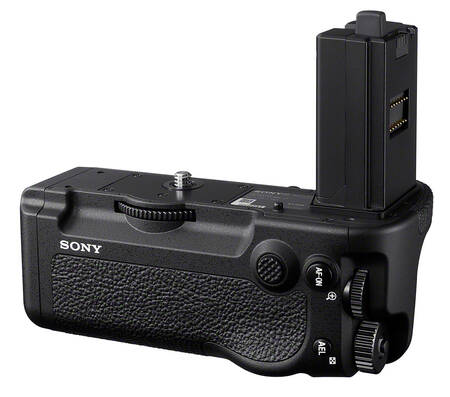
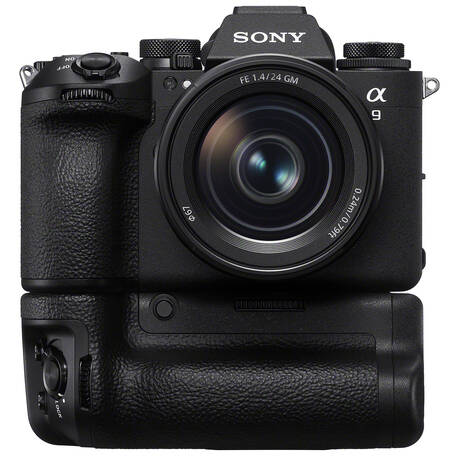
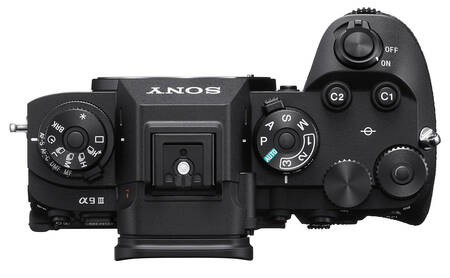
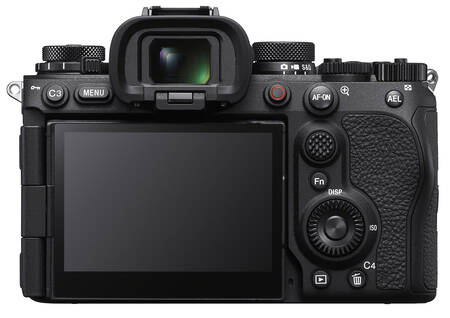
Sony A9 III kamerahus
Sony is now releasing a new version of their fast A9 model. The Sony A9 III is a full-frame camera that revolutionizes the photo industry with a global shutter. A great camera for capturing movement, sports, action, dance, animals and birds. With the global shutter, you can shoot up to 120 frames per second and with images that are completely free from any kind of motion distortion. This allows you to capture those difficult subjects with great accuracy and natural rendering.Distinctive features:
New stacked 24.6MP CMOS full-frame sensor
BIONZ XR processor with 8x more processing power
Global shutter completely free of rolling shutter
Up to 120b/s continuous shooting without black out
AI autofocus with 759 AF points covering 95.6% of the image area
1/80,000 shutter speed (1/16,000 in continuous shooting)
4K/60p recording oversampled from 6K
4K/120p recording with no cropping at all
10-bit 4:2:2 All-Intra video
16-bit RAW
5-axis image stabilization - up to 8 steps
S-Cinetone and S log-3
Quad-XGA OLED viewfinder with approximately 9.44 million dots
"High-speed synchronization" with external flashes regardless of shutter speed
4 axis tiltable 3.2" LCD screen with 2,095,104 dots
Global shutter
The Sony A9 III uses an electronic global shutter which means you can shoot silently, hyper-fast and distortion-free, i.e. completely free of rolling shutter in both video and still images.
What is a global shutter?
Digital cameras commonly use a so-called "rolling shutter". This means that the camera's sensor is read from the top and then down, because of this the subject with a lot of movement can be distorted. That's why many photographers use the slower mechanical shutter to minimize rolling shutter effects, but it's not something you can get rid of completely. In video, rolling shutter is also noticeable when filming fast moving subjects or panning quickly. Whereas a global shutter scans the entire image at once, leaving images and videos completely free of distortion. High speed sync also becomes redundant when using flash, as the camera syncs with flashes at all shutter speeds down to 1/80,000 of a second.
120 frames per second
The A9 III is also capable of continuous shooting at 120 frames per second with the following AF and exposure. In other words, the Sony A9 III is a camera specifically designed for very fast moving subjects.AI autofocus for photos and videos
The camera is powered by an advanced AI processing unit that provides accurate and continuous tracking of your subject. With multiple subject options for eye detection and subject recognition such as people (eyes/face/body), animals, birds, insects, cars, trains and planes, you can rely on the camera to track your subject with outstanding accuracy.
IBIS
The sensor-based stabilization system in the A9 III compensates for up to 8 stops slower shutter speeds, even with non-IS lenses. Sony has also improved communication with lenses that have built-in stabilization in conjunction with the camera's IBIS. The new dynamic active stabilization mode provides over 30 percent more effective image stabilization compared to the existing active mode. However, the dynamic mode crops the image more than the active mode (which also crops the image slightly).
Pre-Capture
The Pre-Capture feature means that the camera starts taking pictures even before shooting, making it much clearer to capture extremely fast-moving subjects such as a bird that suddenly takes off or dives.
Composite RAW
With Composite RAW shooting, the camera takes multiple (4, 8, 16 or 32) images which are then combined together using Imaging Edge Desktop™ software to create full resolution images with lower than normal noise levels. This makes it possible to take, for example, nature images with fast shutter speeds or portraits in low light conditions with very high image quality and low noise even at higher ISO settings. When shooting at low sensitivity levels, the A9 III can also compensate for camera shake when shooting without a tripod and use Composite RAW to create images with better color reproduction.