
Datavideo AD-300 Audio delay Audiomixer
- VAT free purchase available at checkout.
- BrandDatavideo
Description
Article no.: 24928
Datavideo AD-300 Audio delay Audiomixer – 0~3000ms delay with multi-input mixing
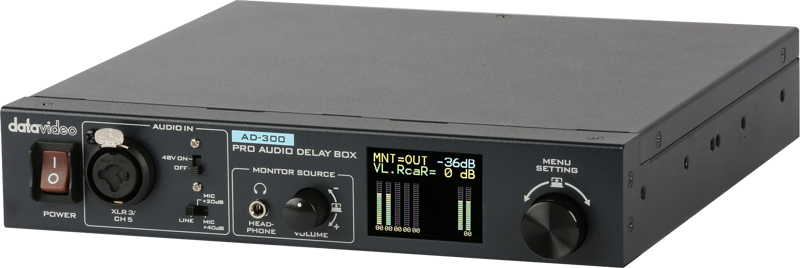
The Datavideo AD-300 is a professional sound delay box designed for multi-function audio production. It provides a wide selection of input and output interfaces along with multiple sound processing tools. Use it to align audio with video, mix several sources, and apply equalization and dynamic effects in a compact unit.
Key features at a glance
- 0~3000ms adjustable audio delay for each input
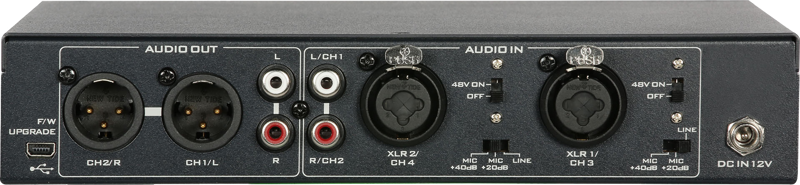
- Multiple inputs and outputs, including XLR and RCA
- Built-in mixing function that selects and combines up to five inputs
- Comprehensive sound processing: equalizer, compressor, limiter, expander and gate
- Balanced/unbalanced audio conversion and switchable mic/line input with +48V phantom power
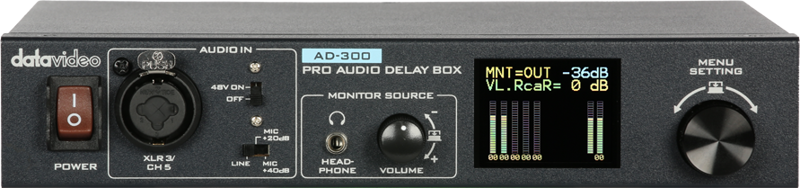
- LCD display for OSD menu and mode selection; suitable for standalone use or rack installation
Inputs and outputs
The AD-300 offers a wide range of input and output interfaces to match studio and field setups. It includes three XLR balanced stereo inputs and two RCA unbalanced stereo inputs. For monitoring and downstream routing, the unit provides two channels of XLR and RCA outputs.
Delay and mixing functions
The AD-300 delivers a sound delay range from 0 to 3000 ms. You can adjust the delay for each input individually in milliseconds, which helps achieve precise audio-to-video synchronization.
In addition, the built-in mixing function lets you select any of the five input sources and combine them into a single output channel. You can also add a Test Tone for volume correction when setting levels or troubleshooting signal chains.
Equalizer and filters
The equalizer on the AD-300 focuses on timbre control. It lets you set specific frequency ranges and adjust only those ranges. The EQ covers 125Hz to 16K Hz in eight frequency bands, with each band adjustable by ±10 dB. Use this to shape tone and correct frequency imbalances.
Furthermore, the AD-300 includes standard audio filters. A high-pass filter removes frequencies below a chosen cutoff, while a low-pass filter removes frequencies above a chosen cutoff. These filters help clean up unwanted low or high frequency content.
Dynamic effects: compressor, limiter, expander and gate
The AD-300 offers several dynamics processors for controlling signal levels and dynamics.
- Compressor — Reduces peaks while preserving lower-level audio. The unit provides a compression ratio up to 100:1 and allows Attack time adjustment from 50 to 500 ms so you can tailor dynamic control.
- Limiter — Limits the maximum volume of a track and is often used in mastering stages alongside compression. The Limiter’s Threshold range is +24dBu to -6dBu, and Attack time can be selected from 50 to 500 ms.
- Expander — Increases dynamic range, making louder and quieter parts more distinct. Use it to add clarity to instruments or vocals when you need more dynamic contrast.
- Gate — Mutes audio when levels fall below a set threshold to eliminate unwanted noise. The Gate threshold on the AD-300 is adjustable from -66 dBu to -25 dBu, which helps remove ambient or breathing noise.
Balanced/unbalanced conversion and mic inputs
The AD-300 features built-in balanced/unbalanced audio conversion to prevent under-volume or popping when formats are mixed. You can switch the mic input between microphone and line modes. The unit supports XLR mic input and offers +48V phantom power for condenser microphones.
Controls, display and installation
Datavideo designed the AD-300 with ease of use in mind. An LCD display presents the OSD menu and mode selection, making navigation straightforward. The chassis suits both standalone operation and installation in a rack, offering flexibility in studio and live environments.
Typical use cases
- Syncing multiple microphones or playback sources to video by applying precise per-input delay.
- Combining several audio sources into a single feed for livestreams, broadcasts or recording using the internal mixer.
- Applying EQ and dynamics processing such as compression, limiting or gating before sending audio to a recorder or PA system.
- Converting between balanced and unbalanced formats to match different equipment without introducing noise or level issues.
Specifications
| Specification | Detail |
|---|---|
| Inputs | 3 XLR balanced stereo inputs; 2 RCA unbalanced stereo inputs |
| Outputs | Two channels of XLR and RCA outputs |
| Sound delay range | 0~3000 ms (adjustable per input) |
| Equalizer | 125Hz to 16K Hz in 8 frequency ranges, each ±10 dB |
| Compressor | Ratio up to 100:1; Attack time 50–500 ms |
| Limiter | Threshold range +24 dBu to -6 dBu; Attack time 50–500 ms |
| Gate threshold | -66 dBu to -25 dBu |
| Mic input / Phantom | XLR mic input; switchable mic/line; +48V phantom power supported |
| Mixing | Select and mix any of five input sources into a single output; Test Tone available |
| Display and form factor | LCD display for OSD menu and mode selection; suitable for standalone or rack installation |
FAQ
Question: Can I sync individual inputs to video precisely with the AD-300?
Answer: Yes. The AD-300 provides a 0–3000 ms delay range and you can adjust each input individually in milliseconds to achieve precise audio-to-video synchronization.
Question: How many sources can I mix and is there a test tone for level checks?
Answer: The built-in mixer lets you select and combine any of the five input sources into a single output channel. You can also add a Test Tone for volume correction during setup.
Question: Does the unit support condenser microphones that require phantom power?
Answer: Yes. The AD-300 supports XLR mic inputs and provides switchable +48V phantom power for condenser microphones.
Question: Can I convert between balanced and unbalanced signals without issues?
Answer: Yes. The AD-300 includes balanced/unbalanced audio conversion to prevent under-volume or popping when converting between formats.
Question: Which dynamics controls are available and what ranges do they offer?
Answer: The AD-300 includes a Compressor (up to 100:1 ratio, Attack 50–500 ms), a Limiter (Threshold +24 dBu to -6 dBu, Attack 50–500 ms), an Expander, and a Gate (threshold -66 dBu to -25 dBu). These let you shape dynamics for recording, broadcast, or live use.