
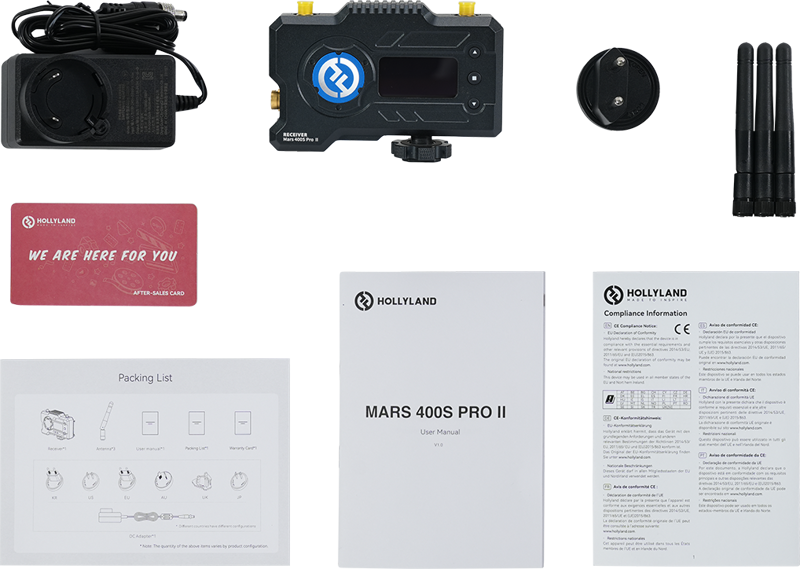
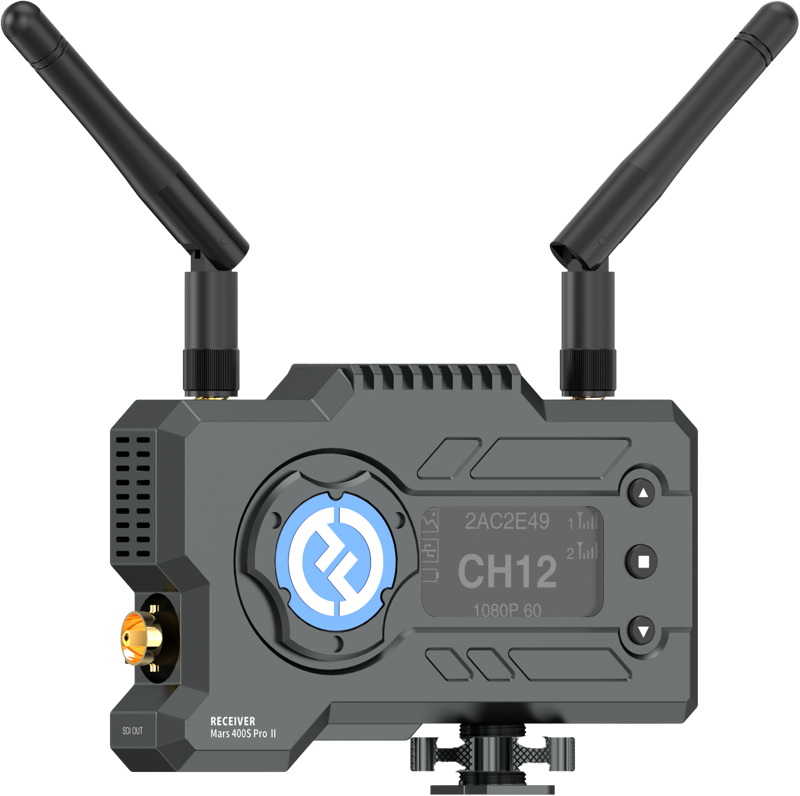
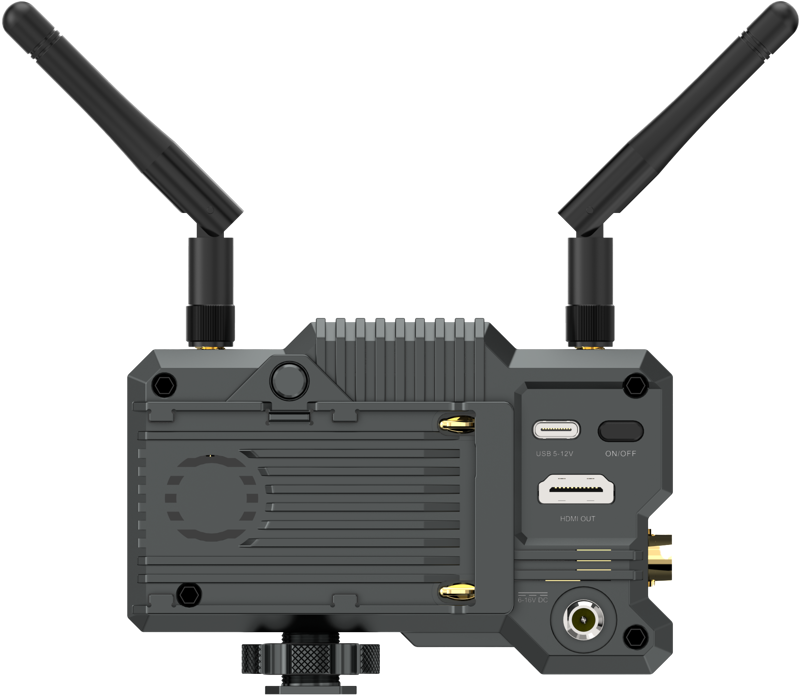
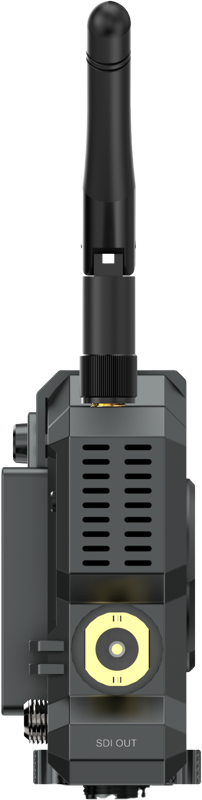
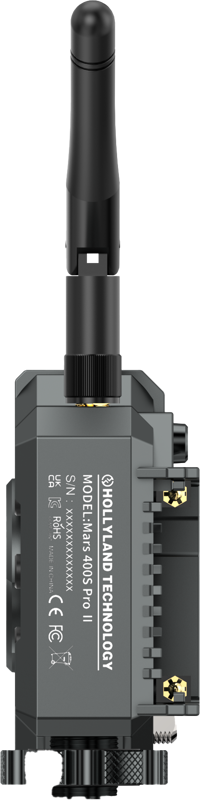
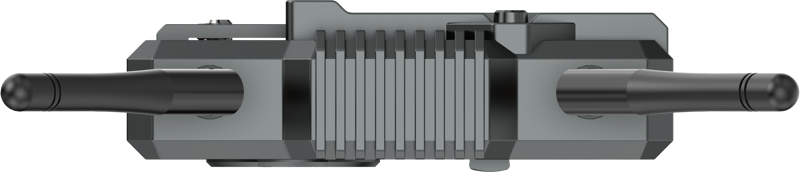
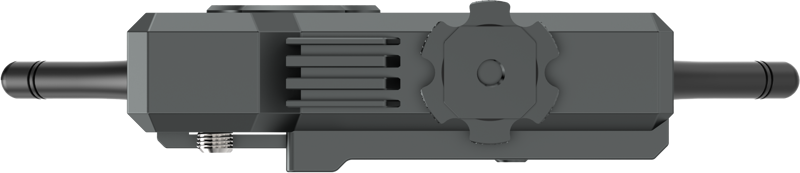
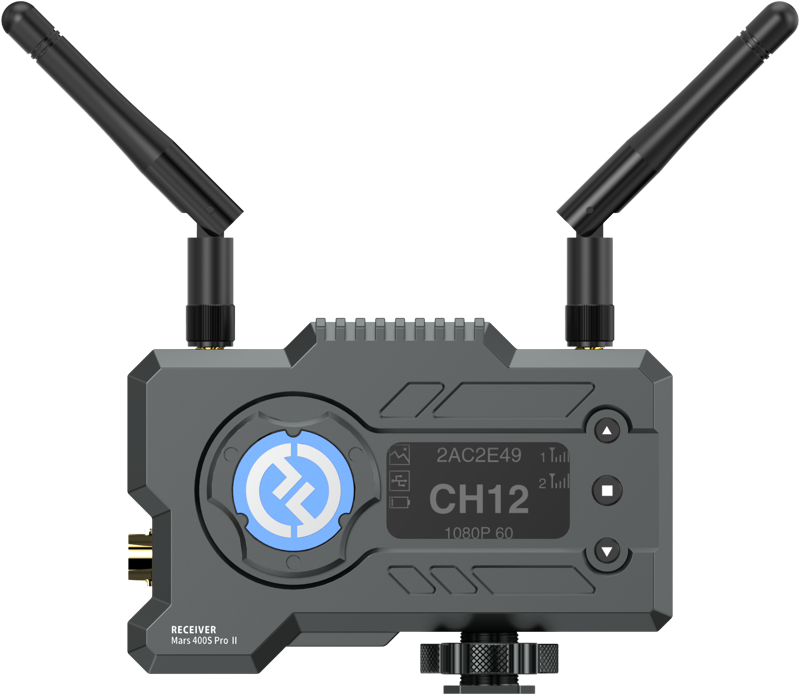
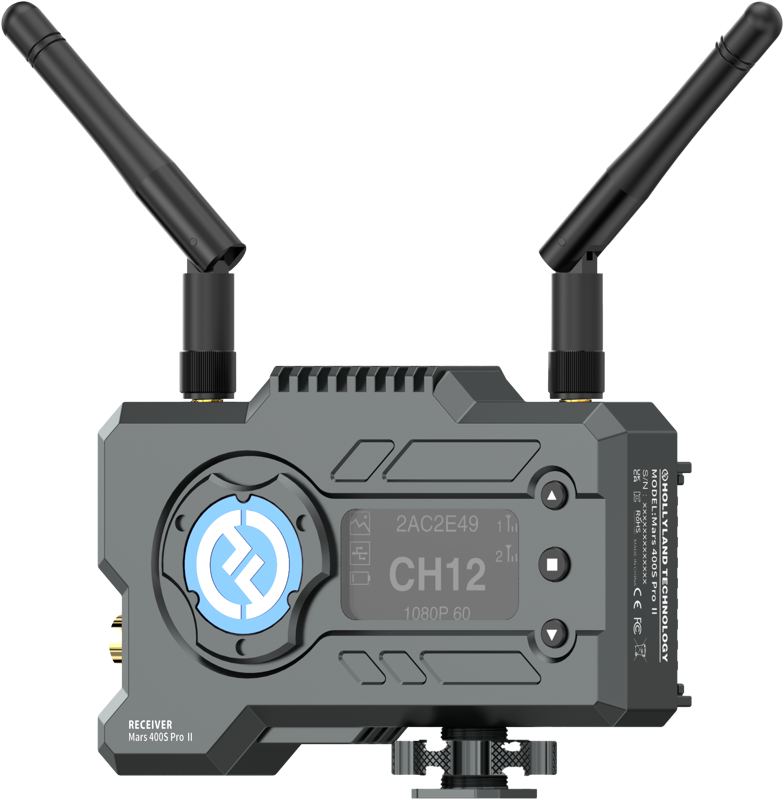
Hollyland Mars 400S Pro Ⅱ SDI/HDMI Wireless VideoReceiver
- VAT free purchase available at checkout.
- BrandHollyland
Description
Article no.: 25266
Hollyland Mars 400S Pro II – 70ms Ultra-Low Latency & 150m Transmission Range
This listing is for the Hollyland Mars 400S Pro II Receiver Only. The receiver delivers an ultra-low latency of 70ms and supports stable wireless video reception at a line-of-sight (LOS) range of up to 150m under interference-free laboratory conditions. It provides SDI and HDMI outputs, a 12Mbps data rate, smart channel scanning, flexible fan control, and an integrated cold shoe for straightforward mounting.
Key Features
- 0.07s (70ms) low latency
- 150m LOS transmission range (lab measurement)
- SDI & HDMI dual ports
- 12Mbps data rate
- Flexible monitoring options via the Hollyview App
- Smart channel scan to find the best frequency
- Flexible fan control with Off, Low Speed and Auto modes
Performance and Range
The Mars 400S Pro II provides a responsive monitoring experience with an ultra-low latency of 70ms (0.07 seconds). Moreover, it supports wireless video transmission at distances up to 150m in line-of-sight scenarios measured in interference-free laboratory conditions. These characteristics make the receiver suitable for workflows that require near real-time monitoring and long-distance transmission stability.
Data Rate and Image Quality
This receiver supports a 12Mbps data rate. As a result, it handles high-definition video streams and preserves detail during transmission where the supported bitrate applies. The device aims to maintain clear and refined image delivery within the stated data-rate capability.
Ports and Device Compatibility
Mars 400S Pro II includes both SDI and HDMI interfaces. Consequently, it connects to a wide range of cameras and output devices, from DSLRs to professional cinema cameras that provide either SDI or HDMI outputs. The dual-port design ensures flexible integration into existing camera and monitoring setups.
Monitoring Options and Multi-Device Support
The receiver supports multiple monitoring configurations to fit different crew needs. The listed monitoring setups include:
- 1 Transmitter × 2 Receivers
- 1 Transmitter × 1 Receiver & 2 Hollyview App connections
- 1 Transmitter × 4 Hollyview App connections
Therefore, teams can mix hardware receivers and app-based monitoring for collaboration, multi-crew oversight, or multi-member cooperation during shoots.
Smart Channel Scan
The Mars 400S Pro II performs automatic channel scanning on startup to select optimal frequency channels. In addition, users can run channel scans from the receiver or through the Hollyview App. The scan provides a visual representation of interference levels across frequencies, which helps identify the most suitable channel quickly.
Flexible Fan Control (Including Silent Option)
The receiver offers a three-position fan control system: Off, Low Speed, and Auto. Each mode serves specific usage needs:
- Auto: The device adjusts fan speed based on temperature for efficient cooling during standard operation.
- Low Speed: The fan runs at a reduced speed to lower noise output in quieter environments.
- Off: The fan stops completely to provide a silent operation mode when absolute silence is required.
These fan options allow users to balance cooling performance and noise levels depending on the shooting environment.
Integrated Cold Shoe
The receiver features an integrated cold shoe with a 1/4-inch threaded cold shoe interface. This built-in mounting point simplifies installation by allowing direct attachment to compatible cold shoe slots on cameras and accessories without additional adapters.
| Specification | Details |
|---|---|
| Latency | 0.07s (70ms) |
| LOS Range | 150m (based on interference-free laboratory measurements) |
| Data Rate | 12Mbps |
| Interfaces | SDI & HDMI dual ports |
| Monitoring Configurations | 1Tx × 2Rx; 1Tx × 1Rx & 2 App; 1Tx × 4 App |
| Fan Modes | Off, Low Speed, Auto |
| Mounting | Integrated cold shoe with 1/4-inch threaded cold shoe |
FAQ
Question: What does "Receiver Only" mean for this listing?
Answer: The product description explicitly labels the listing as "Receiver Only." The description therefore refers specifically to the receiver unit of the Hollyland Mars 400S Pro II.
Question: How many devices can monitor the same transmitter feed?
Answer: The receiver supports multiple monitoring setups, including 1 transmitter with 2 receivers, 1 transmitter with 1 receiver plus 2 Hollyview App connections, and 1 transmitter with 4 Hollyview App connections, allowing flexible team monitoring configurations.
Question: How does the smart channel scan help on set?
Answer: The smart channel scan automatically finds the best frequency channels at startup and can also be run from the receiver or the Hollyview App. It displays interference levels per frequency so you can quickly select the least congested channel for stable transmission.
Question: What fan control options are available and when should I use them?
Answer: The Mars 400S Pro II provides Off, Low Speed and Auto fan modes. Use Auto for balanced cooling, Low Speed to reduce noise in quieter environments, and Off when you need silent operation and can tolerate reduced active cooling.