
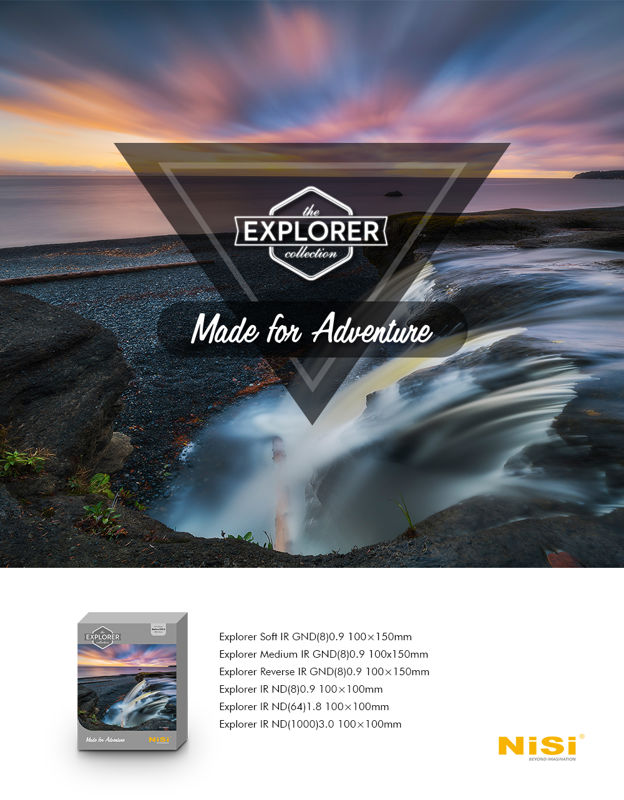
NiSi Square Filter Explorer 100x100mm IRND 1000 10Stops
- VAT free purchase available at checkout.
- BrandNiSi
Description
Article no.: 28519
NiSi Square Filter Explorer 100x100mm IRND 1000 10Stops – B270 Tempered Glass with IR and Nano Coatings
The NiSi Explorer 100x100 mm IRND 1000 (10 stops) is a neutral density filter built for outdoor and active photographers. It uses special B270 tempered glass that makes the filter more resistant to accidental breakage than standard glass filters. In addition, it features an IR coating and NiSi’s Nano coating that repels dirt, water and oil.
Built for adventure and everyday use
The Explorer series uses hardened glass designed to be much less prone to accidental breakage. As a result, the filters suit photographers who work in active environments and need reliable gear. However, note that the tempering and hardening process reduces the risk of damage but does not make the filter unbreakable, and the effect of hardening may decline over time.
Key features
- 100 x 100 mm square filter format for NiSi 100 mm filter systems.
- IRND 1000 / 10 stops density for strong light reduction in bright conditions.
- B270 tempered glass for increased durability compared with typical glass filters.
- IR coating to control infrared contamination.
- NiSi Nano coating that repels dirt, water and oil for easier cleaning and maintenance.
- Compatible with lenses that have filter threads from 49 mm to 95 mm when used with appropriate adapter rings.
| Specification | Detail |
|---|---|
| Size | 100 x 100 mm |
| Type | Neutral Density (IRND) |
| Density / Stops | ND1000 / 10 stops |
| Glass | B270 tempered glass |
| Coatings | IR coating; Nano coating (dirt, water and oil repellant) |
| Compatibility | NiSi 100 mm filter system; lenses with filter thread 49 mm to 95 mm |
| Durability note | Hardened to be less prone to accidental damage; not unbreakable and hardening may decline over time |
How to choose an ND filter — quick guidance
Neutral density filters reduce the amount of light entering your lens, letting you use slower shutter speeds or wider apertures for motion blur and shallow depth of field. Below are typical uses for common ND strengths to help you choose the right filter.
-
ND8 / 3 stops:
Commonly used for waterfalls and flowing water. ND8 typically enables shutter speeds from around 0.5 seconds to 2 seconds to record smooth motion in water while keeping some texture.
-
ND64 / 6 stops:
Often used around the golden hour (shortly after sunrise or before sunset). ND64 helps you reach exposures of 1–2 minutes to create very smooth water or cloud movement, while still preserving some dynamic detail when desired.
-
ND1000 / 10 stops (this product):
Designed for daytime use when ambient light is bright and requires strong light reduction. ND1000 allows much longer exposures during daylight and, with appropriate settings, can extend exposures up to about 5 minutes during the golden hour.
Practical tips
- Use adapter rings to mount the 100 x 100 mm filter on lenses with different thread sizes (49 mm–95 mm).
- Combine the filter with a sturdy tripod for long exposures, especially when using ND1000 in daylight.
- Clean the Nano-coated surface gently; the coating helps repel contaminants but does not eliminate the need for careful handling.
Smart FAQ
Question: Will this 100x100 mm filter fit my lens?
Answer: The NiSi Explorer 100x100 mm filter is designed for the NiSi 100 mm filter system and can be used on lenses with filter threads from 49 mm to 95 mm when you use the correct adapter ring.
Question: How durable is the tempered B270 glass?
Answer: The B270 tempered glass used in the Explorer series is hardened to make it much less prone to accidental breakage compared with standard glass filters. However, it is not unbreakable, and the protective effect can decrease over time.
Question: Does the filter change image color or introduce infrared issues?
Answer: The filter is engineered not to affect image coloration and includes an IR coating to manage infrared contamination, helping preserve accurate color rendering.
Question: How should I maintain the Nano coating?
Answer: The Nano coating repels dirt, water and oil, which makes cleaning easier. Nevertheless, you should wipe the filter gently with appropriate tools and avoid abrasive materials to maintain the coating’s effectiveness.